In the past year, I’ve read three books about reading and books. I’ve been working on a document reader, so I thought that it would be a good idea to learn from people that have already thought about how we read.
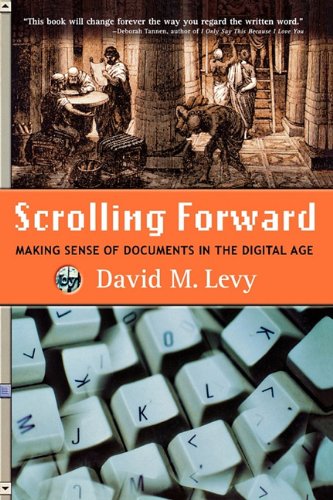
Scrolling Forward (1)
When most people think of documents, they think of the big things: books, articles, bills, and the like. Instead of starting off with these, Levy uses the lowly example of the receipt to address the question of what exactly a document is. He points out that the receipt as a document is not just a piece of paper, but a cultural artifact that only gains meaning through how we interact with it. There are many unwritten assumptions we make when we deal with documents — for example, when we use receipts, we assume that they will be adequate proof of our transaction at a later date.
He then goes into the historical context behind how each type of document developed its form and function. He explains that much of the bureaucracy that we deal with from day to day is a result of the Industrial Revolution. Increases in distances and production meant that the handling of logistics in large organisations quickly became complex. Writing had to likewise become faster and thus, the memo was born. Now that there was so much paper flying around, naturally, the filing cabinet was created. Many of the office supplies that we take for granted were invented to adapt to these changes in how we worked.
Another point that Levy makes is how print has developed a system of trust that we still have not replicated in the digital realm. The system of book publishers, editors, reviewers, and libraries provide an infrastructure for fact-checking, distribution, cataloguing, indexing, versioning, and preservation that facilitate our interactions with literature. Again, because of all this infrastructure, we make assumptions about the information we get from books that their electronic counterparts lack. Levy recalls a medical visit he made where the doctor needed to verify a fact in order to make a diagnosis. Instead of looking in a textbook, the doctor suggests searching for the information online. There is a fleeting moment where both Levy and the doctor pause to justify their trust in the electronic information — a justification that would not occur with a textbook. This infrastructure was developed over a very long time1 and duplicating it for electronic books will take some effort.
To me, the most important thread in Scrolling Forward is Levy’s commentary on two different kinds of interaction with documents. Levy presents these two modes through the figures of Walt Whitman and Melvil Dewey. Walt Whitman represents the ephemeral experience of reading as an activity. By pointing out that Whitman constantly tinkered with the interpretation of even his earliest work by issuing new editions, Levy illustrates that a document is rarely static. The passage of time and the reader’s shifting life experience determine how we understand a document. This sort of interaction requires introspection — we allow the document to speak to us and we reflect on not only the semantics of what we read, but how the text is connecting our thoughts to the author’s. It is this connection that characterises what Levy terms the “spiritual” side of reading.
This is in contrast to the more rational side of reading represented by Melvil Dewey. Dewey has had a huge impact on how we deal with information. In his twenties, not only did he invent the Dewey Decimal Classification system, but also founded The Library Journal and was among the founders of the American Library Association. He was quite a meticulous thinker — to the point that his attempts at spelling reform extended to his own name, which he changed from “Melville” to “Melvil”. He was very much a product of an aged that strove for efficiency and our present age echoes the same sentiments. As such, Levy associates with Dewey the kind of thinking that is primarily “information-seeking”, which thrives in an environment where information is organised and readily available. This describes Dewey’s libraries quite well, and in some ways, the Internet has been an improvement in terms of scale and speed.
Consequently, Levy likens Whitman to the technology of paper and Dewey to the screen. These technologies, of course, do not occur in isolation, as paper has bookstores and reading rooms and screens have the Internet and search engines. Each technology has ardent supporters that bemoan the existence of the other, but he notes that both can co-exist in a supplementary fashion; they can each support very different ways of thinking. In fact, 12 years later, in 2013, it seems that they are doing just that — e-books have not replaced paper books and the Internet has not replaced libraries: book readers use different technologies to fulfill different needs.
However, Levy makes an assertion that we are beginning to lean more towards the Dewey style of thinking and that this is a dangerous trend for the future. Because this style is so focused on seeking information, it downplays the importance of the kind of environment we need to facilitate lateral thinking. He explains this more in a Google Tech Talk titled "No Time to Think" (March, 5 2008). New technologies and the world’s never-ending drumbeat are vying for our attention which could be spent thinking about problems creatively. IBM’s "Paperwork Explosion"‘s key phrase ("machines should work; people should think") sounds quite cloying when we realise that machines are making us "think different", but not more effectively. This is important to me because I enjoy joining different threads and finding links between subjects. Losing this ability is particularly disturbing as I believe complex problems require interdisciplinary thinking.
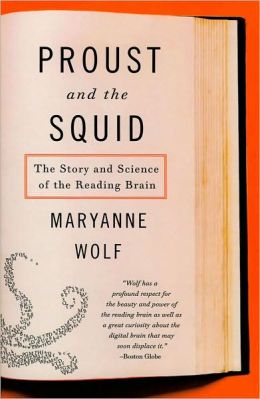
Proust and the Squid (2)
Whereas Scrolling Forward is more about our sociocultural interactions with written language, Proust and the Squid looks at the neuroscience of reading and how it changes how we think. I previously wrote about some of the thoughts I had while reading this book, but I’ll expand on more of the book’s content.
Firstly, Wolf discusses how the brain was never meant to read. Our ability to see glyphs hijacks parts of our brain that are used for object recognition and the development of the alphabetic principle hijacks our speech processing circuits. This reuse is just another example of the brain’s amazing neuroplasticity.
There is some discussion of humanity’s early history with written language and Wolf takes this opportunity to share the how different writing systems use different parts of the brain. Quite literally, the brain of a Chinese reader is different from that of an English reader when viewed with the tools of functional imaging. Later on, Wolf writes about Socrates’ rebukes of reading (in Phaedrus) which I found to be extremely interesting. Socrates’ first objection is based on his view that written language does not dialogue with the reader the same way a teacher would with a pupil. Wolf and many others argue that reading dialogises differently and written language has advanced in ways Socrates never foresaw. Socrates’ second objection is raised from his elevation of oral culture’s capacity for memory — in his view, written language will diminish this capacity to the point that students will no longer be able to achieve of the fluidity of retrieval needed for dialogue. Socrates’ final objection is that reading will make knowledge available to those that do not appreciate it fully. It will give people a false impression that they have knowledge when they have only understood the surface. This recalls Levy’s arguments in “Scrolling Forward” and Wolf also wonders if the Internet will have a similar effect on readers.
Much of the rest of the book is devoted to explaining how the brain adapts to written language in the few years of childhood, a development which took humanity many millennia to attain. As you can imagine, there are lots of potential stumbling blocks in this marathon. Wolf has separated learning to read into the stages of: 1) emerging pre-reader, 2) novice reader, 3) decoding reader, 4) fluent comprehending reader, and 5) expert reader. As I read about the details of each stage, I joyfully saw the points in my own reading development where I entered each stage; Wolf shares her own experiences in each stage as well as those of children that she has helped at the Center for Reading and Language Research. She closes with a description of the intricate neural pathways that allow expert readers to decode and understand words in the space of hundreds of milliseconds.
The final part of the book discusses when the brain can not learn to read — dyslexia. As a society, we make many assumptions about literacy that may need to be rethought. There is a stigma associated with unfluent reading that can be quite damaging to those with dyslexia especially if it remains undiagnosed. Wolf expands upon the neural pathways involved in reading with several theories as to why dyslexics have difficulties reading. She stresses that, at a very basic level, dyslexics’ brains work differently and that we should embrace the creativity that comes from that.
Wolf really loves the reading brain and after reading this book I watched a recording of a her book discussion on C-SPAN. Her enthusiasm there matches what I encountered in her book perfectly.
Reading and Writing the Electronic Book (3)
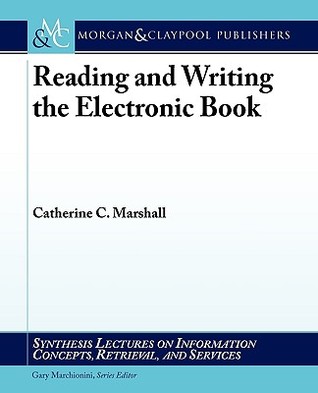
This book is more concrete when it comes to designing my document reader. It is mainly a review of prior work in the design of e-books and psychological studies of how we read both on paper and electronically. I found Marshall’s characterisation of the different kinds of reading quite informative and early on, it stressed to me that the needs of readers can vary greatly. This theme is carried throughout the book, for example, in the study of annotation types and of group reading.
Catherine Marshall references David Levy when she calls reading an “inherently social” activity. That is why I am writing this review, right? Readers discuss what they’ve read on their own, and in some cases of group reading, discuss what they’re reading through shared focus. Studying these kinds of interactions between readers may help facilitate collaboration.
However, reading studies are difficult to run because watching people read is considered “creepy”. When it comes to doing a study on electronic-based reading, one could use both eye-tracking and software instrumentation to log the reader’s interactions. I actually plan on doing this, because I am interested in the aforementioned different reading strategies and how an interface can shift to accommodate each one.
The final chapter is really worth a read because it talks about all the different ways we can bring the book into the digital age by giving it capabilities that are difficult to realise with paper. Some, such as search and hypertext, have been done many times, but there is still room for improvement. Others, like document triage and browsing, really must be incorporated into tools that the general public can use so that electronic books can achieve parity with paper.
I think one thing I got out of this is that to validate my designs, I will have to do user studies. When I get to that point, I’ll write another blog post!
The Middle Ages Tech Support skit imagines how the codex might have been introduced in the Middle Ages. ↩
Bibliography
[1] David M. Levy: “Scrolling Forward: Making Sense of Documents in the Digital Age”. Arcade Publishing. New York, NY. 2001. ISBN: 978-1559706483
[2] Maryanne Wolf: “Proust and the Squid: The Story and Science of the Reading Brain”. HarperCollins. New York, NY. 2007. ISBN: 978-0-06-018639-5.
[3] Catherine C. Marshall: Reading and Writing the Electronic Book. Synthesis Lectures on Information Concepts, Retrieval, and Services. Morgan & Claypool. 2009. doi:10.2200/S00215ED1V01Y200907ICR009.
I have been reading the book “Proust and the Squid: The Story and Science of the Reading Brain” (ISBN: 978-0-06-018639-5) by Maryanne Wolf and learning quite a bit about the cognitive processes behind reading. One concept that was explained in the book was how reading uses areas of the brain that are used for object recognition and voice recognition, especially for writing systems that make use of the alphabetic principle.
This led me to think about how I use the computer — I have noticed that
whenever I try to talk about code or explain commands orally, I often
have no fixed pronunciation for symbols such as char, ls, PNG, or
execvp. This is because I don’t internally sound out these words. This
“sounding out” while reading is called subvocalisation1.
Subvocalisation has been theorised to have a role in lexical retrieval
as well as semantics in reading — though the specific roles may differ
based on the skill level of the reader (1). In addition, it
may have a role in the mechanisms of working memory and encoding.
The fact that I rarely do this subvocalisation seems to imply that I am reading the symbols differently than I would read a book. This may be because I am not trying to decipher the meaning of the words in the same way. Natural language often has a complexity that comes from features such as ambiguous grammars and homographs which can change the meaning of a sentence as it is read23.
It would be interesting to do research into the different kinds of cognitive processes used in different parts of programming (e.g. writing code, reading documentation, debugging). What part does the type of notation play in how we read code? We could compare programming in a verbose language such as COBOL or a terse language such as APL. What about programmers that do not speak English as a first language? Most programming languages and APIs use English symbols, so how is this related to learning and memory? Do non-native English speakers translate the symbols to their own natural language first or do they view the symbols as purely abstractions?
There has already has been some work done on using subvocalisation (using electromygraphy) (2) and (eye-tracking) (3) to understand what programmers are doing while programming. There is also a group of researchers interested in the psychology of programming. This research could possibly useful for understanding how we work with other kinds of notations, such as mathematics and music.
As far as I can tell from the literature, subvocalisation is a specific type of inner monologue (or inner speech) that occurs during reading and writing. Unfortunately, many papers only use one of these terms and it can be confusing as to what exactly they are referring to. ↩
Physiologically, these ambiguities are usually smoothed over by saccadic eye movements (4). ↩
See garden path sentences such as “Time flies like an arrow; fruit flies like a banana”. ↩
Bibliography
[1] Daneman, Meredyth and Newson, Margaret: Assessing the importance of subvocalization during normal silent reading. Reading and Writing. 1992.
[2] Parnin, Chris: Subvocalization - Toward Hearing the Inner Thoughts of Developers. ICPC 2011: 197-200.
[3] Bednarik, R., Myller, N., Sutinen, E., Tukiainen, M.: Program Visualisation: Comparing Eye-tracking Patterns with Comprehension Summaries and Performance. In proceedings of the 18th Annual Workshop of the Psychology of Programming Interest Group (PPIG'06), Brighton, UK, September 7-8, 2006, pp. 68-82.
[4] Rayner, Keith: Eye movements in reading and information processing: 20 years of research. Psychological Bulletin. 1998.
This perplexing video uses some rather clever camera tricks and simple physics. The link gives an explanation of how it is done, but not why. :-P
Video Description:
Fishing under ice (ORIGINAL)
Uploaded by juusdo on Jan 2, 2012
Some under ice views from beautiful lake Saarijärvi in Vaala, Finland
Divers:
- Fisherman: Eelis Rankka
- Fisherman's friend: Tommi Salminen
- Boy with the balloon: Jukka Pelttari
Camera and editing: Juuso Mettälä
Manuscript by Juuso Mettälä and Eelis Rankka
Safety divers: Esa Vuoppola and Juhana Heino
Music: Stefano Mocini: The end of the doubs
Couple of things about this video:
Camera I used was Sony HDR-SR11 with Amphibico HD Elite housing.
The Wheelbarrow was saved from the bottom of the lake and I have used it many times after that.
The rubber duck and the balloon are also home with me.
None of the divers got any permanent damage either.
And yes, we had a lot of fun making this video.
-Juuso
Link: Finnish Underwater Ice Fishing Mystery Finally Solved : Krulwich Wonders... : NPR

Link: Why We Can't Solve Big Problems - MIT Technology Review
The article that is featured on MIT TR's cover for this month very much aligns with my thinking about innovation. We are not innovating at the level that humanity did in the not-so-distant past. We are working on short-term ideas that are only incrementally better than what was available previously rather than creating solutions that transform society. The major problems that humanity faces are widely acknowledged, but nobody is solving them adequately. The article argues that the reason we are not solving these large problems is because society both lacks the environment needed to develop and test ideas for these hard problems and we are using the wrong tools to solve problems. Furthermore, the challenges we face now are different from the ones in the past and require theoretical underpinnings that we are still developing — in short, these problems are much more complex.
One interesting idea that I took from the article is that not all problems are technological in nature — specifically the example given about Amartya Sen 's work which states that the cause of famine is not from an actual shortage in the food supply, but a problem with food distribution which is more likely caused by economic or political reasons rather than simply agricultural inefficiency.
In other news, I just found out that the magazine had decided to go digital first in June.